Bagel Overload.

Not long ago, I accidentally sent the remarkable Bob Brihn a gift of 48 Zabar’s bagels.
How," you might ask, “does one send such a surfeit of bagels and do it unintentionally?” My answer paraphrases a long-dead politician: “You check a box here, you check a box there, pretty soon it adds up to 48 bagels.”
Of course, events of this sort aren’t just random incidents on the space-time continuum. They come with consequences.
In this case, the thing to know is that Bob doesn’t live in what New Yorkers call a “doorman building,” where arrivals are noted and the resident flagged. Packages are stashed separately, and unless a recipient happens to check, the stuff just sits.
And sits.
All while erupting in the sickly grays, slithery blues, and vomitous greens of the mold spectrum.
I don’t even want to think about what would have been happening inside the accompanying package of lox.
Instead, I want to think about unintended consequences.
After all, we live in a world where the improbable is rapidly becoming everyday.
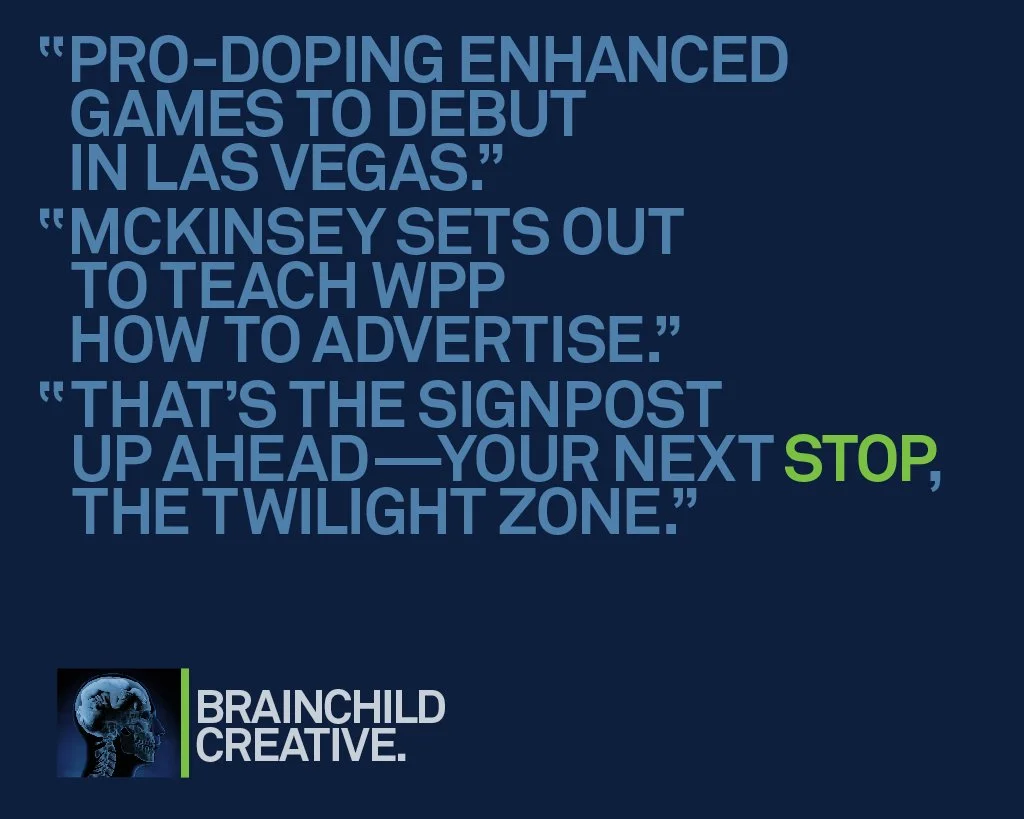
A modern BT Barnum decides the road to huge gate and lucrative TV and streaming rights runs through Las Vegas and something called the “Enhanced Games.” The premise is an Olympic-style competition where athletes are not only invited but encouraged to use performance boosting drugs.
In one of the creepier bits of sophistry, he presents this as a hacking of human biology to explore the future of “super humanity.”
Super worrisome, say I, because of those pesky consequences.
The chipping away of ethical standards. The erosion of competitive fairness. And that niggling little problem about what doping does to the dope-ee’s life expectancy.
You only need to look at what’s happened to the red, white, and sadly blue since 2016 to see how small cracks in what’s okay can swiftly turn into gaping, bleeding, pustulant gashes.
Okay, there's that.
Then there's what's happening in a related dimension with the new CEO of ad giant WPP engaging McKinsey to conduct a “strategic review” re: spiraling fortunes.
The adland cynical – that would be all of us – instantly thought, “Oh goody, a consulting firm is going to teach WPP how to advertise.”
Actually, it's worse.
If you’ve crossed paths with McKinsey, you know their playbook heavily revolves around centralization and decentralization — how much of an iron grip you want from the top of the org chart, versus how much autonomy is afforded to the operating units.
Since their agencies are the units, and since McKinsey generally recommends doing the exact opposite of whatever has been done, it takes no peering around corners to know what’s next.
Control will flow top-ward, centralized tech will supplant creativity, "efficiencies" will be found, and, of course, headcount eviscerated.
The unintended part: what the tectonic changes that follow will do to advertising as a whole. Not to mention our careers.
But, hey, at least we know where there's plenty of well-aged bagels to eat.