Advertising has a big problem with small.

Not in the sense of large wolves looking down-snout at succulent sheep and licking slavering jaws.
It’s more about an industry that used to be all in on big ideas and big dreams becoming hellbent on diminution, reduction, and shrinkage.
The risk is what starts at the tippy top, at least if size is your yardstick, flowing where the smelly always flows.
If you follow the trade press, I don’t need to recycle the gut punches from Omnicom now cutting $1B in "labor costs," and WPP ditching about 7,000 jobs in 2025 with more to come.
Nor do you need any more reminders that agencies, led by all three top holding companies, are eagerly sucking at the AI crack pipe by way of further reducing the need for pesky humans irritatingly demanding to be paid.
Taken as a whole, it seems adland is determined to turn Jay Chiat’s famous muse, “how big can we get before we get bad" into "how small can we get before we're irrelevant?"
This bodes poorly for both happy careers and happy endings.
Particularly if you realize that what all that sucking-up-to-Wall Street streamlining means is sacrificing the one remaining advantage we've maintained over the technology behemoths who’ve swallowed most of the ad budgets, whole.
That soon-to-be-former ace in the cubes: human talent, with its indelible connections to leap-of-intuition creativity, cultural fluency, and market ubiquity.
Now, don’t get me wrong. I’m clearly not saying bigness for its own sake is anything we should wistfully recall through rose-colored Oakley-Meta's.
Bigness becomes inevitably draped in bureaucracy, invariably run by people who have more invested in saying “no way” than “why not,” and almost exclusively driven by C-suites seeking greater compensation and higher share prices.
All of which are antithetical to the kind of brilliantly unexpected and emotional work which, thanks to System1 we now know is brand-mandatory.
Hence, the moral of our story:
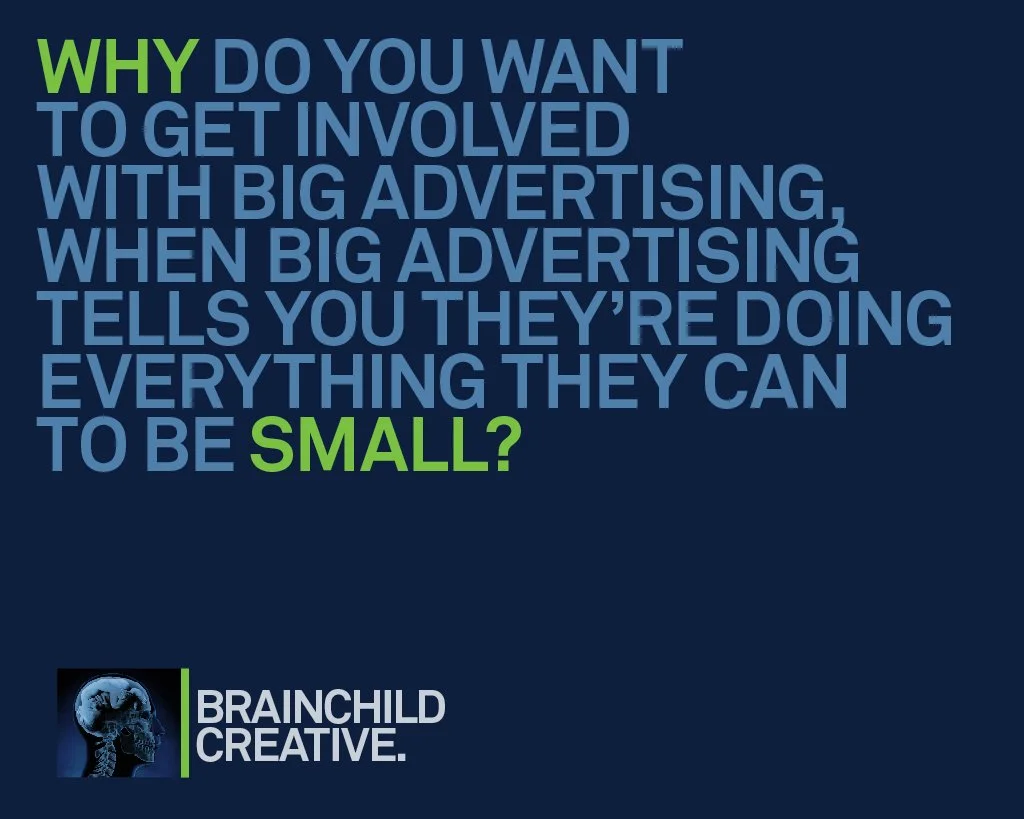
Call it a case of mistaken identity, or losing their own plot, but it now seems the bigs are increasingly consumed by getting smaller in every sense of the word. Smaller operations, smaller ideas, smaller whatevers.
Meanwhile, I'm pleased to report that those of us already in the desired end state — small, agile, and fiercely anti-layer and -nay-saying — never stopping thinking, and dreaming, big.
Which brings us to this question: