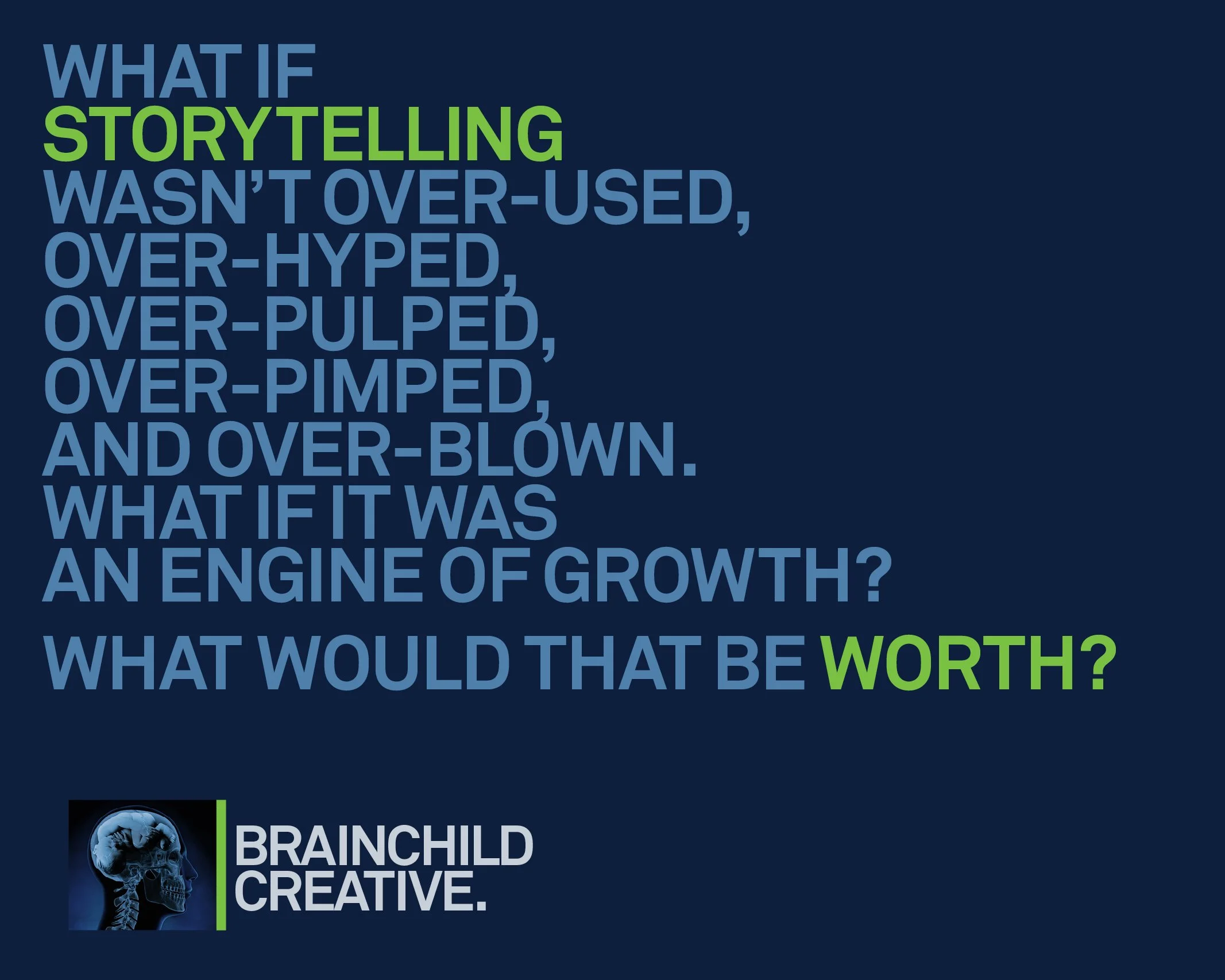
The story engine.

Three score and twelve years ago, Peter Drucker famously observed, “A business has only two functions: innovation and marketing.”
At the risk of stepping on the master’s inevitably leather-patched and chalk-smudged corduroy jacket, I think we're past due for a friendly amendment: “A business has only two paths to growth: innovation and storytelling.”
And yes, I get that the word “storytelling” might make you want to throw up in your mouth, just a little.
Over the last few years, it’s been overused, overhyped, over-pulped, over-pimped and overblown—not to mention hung on way too many capabilities presos and creative résumés like cheap and tawdry costume jewelry draped around the neck of the desperate to be noticed.
But if you can hold the hurl for a moment, I’ll do my best to serve up the rationale.
Drucker’s central point was that innovation creates a new or better form of value; marketing then turns that value something that is relevant, recognizable, desirable, and accessible to the customer.
All well and good. But that was then, when the world wasn’t fragmented into a million mirror shards reflecting the illusion of cogent media, coherent audiences, and dependable channels.
Enter the need for something more adapted to the times.
Assuming we can dispense with all the dreary baggage that comes with the word, this is where storytelling fits the scheme.
Innovation changes reality. Storytelling gives it meaning.
Seen in that light, storytelling can't be glibly dismissed as some trying-too-hard video, cheesy founder anecdote, or similar narrative fluff.
And it's definitely not about telling a story for its own sake.
Instead, it's the strategic act of organizing values, facts, evidence, and vision into a compelling structure that people can understand and act upon.
Along the way, answering the defining questions that underpin everything else:
What business are we in?
What change are trying to create?
Why should our audiences should care about that change?
What conflict or problem do we address?
What makes our approach unique?
Why should we be trusted?
What role will the customer play in the outcome?
Do this properly, and you're ready to fill in the blanks that let you effectively solve the marketing, advertising, or performance problems that follow.
Difference: we are the only ________.that ________.
Distinctiveness: among all the _______, that ________, we stand out because ______.
Of course, as we all learned in grade-school, every story has a beginning, a middle, and an end. And those two oh-so-simple, oh-so-maddening sentences clearly fit in the first category.
How they turn into the middle and end—now that’s a conversation worth having.