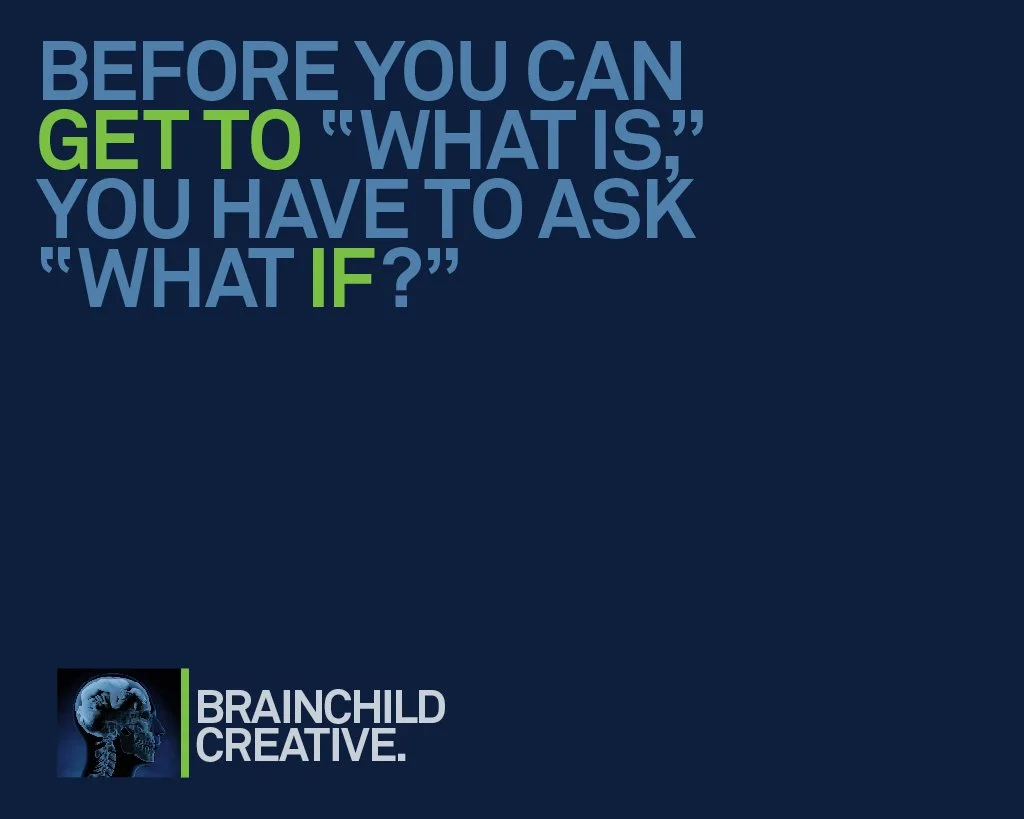
“What is” is mundane. “What if” is magic.

For proof, just try letting the two phrases roll around your mouth and your mind.
If you don’t get even the tiniest frisson from the latter, better check your pulse.
But I’d make you a double King Cole martini, bet that won’t happen. Make it a triple if you attach “what if” to something top of mind — that immediate creative assignment, that upcoming career choice.
Without “what if,” "what is" is left with sackcloth and ashes, especially in an adland rent by pre-holiday losses, layoffs, and endings.
With "what if": we have incredibly fertile tillage for whatever is that’s new, next, and better.
As a general matter, “what is” hits the brakes while simultaneously downshifting into an unavoidable collision with what the historian Jon Meachum calls “the narcissism of the present”— a belief that whatever we’re going through is excruciatingly worse than anything experienced by people in previous times.
By contrast, “what if” ignites the inspiration engine and propels the kind of ideas that turn a swing at the mundane into the proverbial homer.
To be clear, “what if” doesn’t turn a blind eye to the situation. Nor does it let itself get hung up on playing the fishbowl guppy and the shiny quarter game with what’s currently in view.
Lately, I've been thinking we too often start solving too many problems with a cyclopean eye on “what is.”
In brand marketing, even the mandatory statement of objectives — “what if” territory if ever was — winds up being an updated version “what already is."
We settle for something on the order of "our goal is to increase widget sales by 10% YOY" instead of "what if we made our widgets the most famous widgets in the whole widget world?"
As a result, we start out with one metaphorical foot in a bucket of congealed real-world concrete.
But let's take it further: I’d argue that one way for creative to regain its primacy in adland is for creatives to step up as the champions of possibility.
Our message: before you can get to any “what is” that’s worth a damn, you have to start with “what if.”
To make that point even more practical (and self-promotional), here’s what the remarkable Bob Brihn and I did with it a few years back - https://lnkd.in/eGKuCxFi
And I keep seeing others playing in the same infinite sandbox. GE (bastards). The Apollo retirement firm headlining a full-page Journal ad with a huge “What If” (double bastards).
That's because there's method in the recursive madness: System 1 tells us that emotion is our most powerful tool in selling products, companies, brands, and ourselves.
That being the case, it’s worth asking which is the more powerfully motivating and emotional — “what is” or “what if?”
Answer with the first and, like I say, check your pulse. You might be dead.