
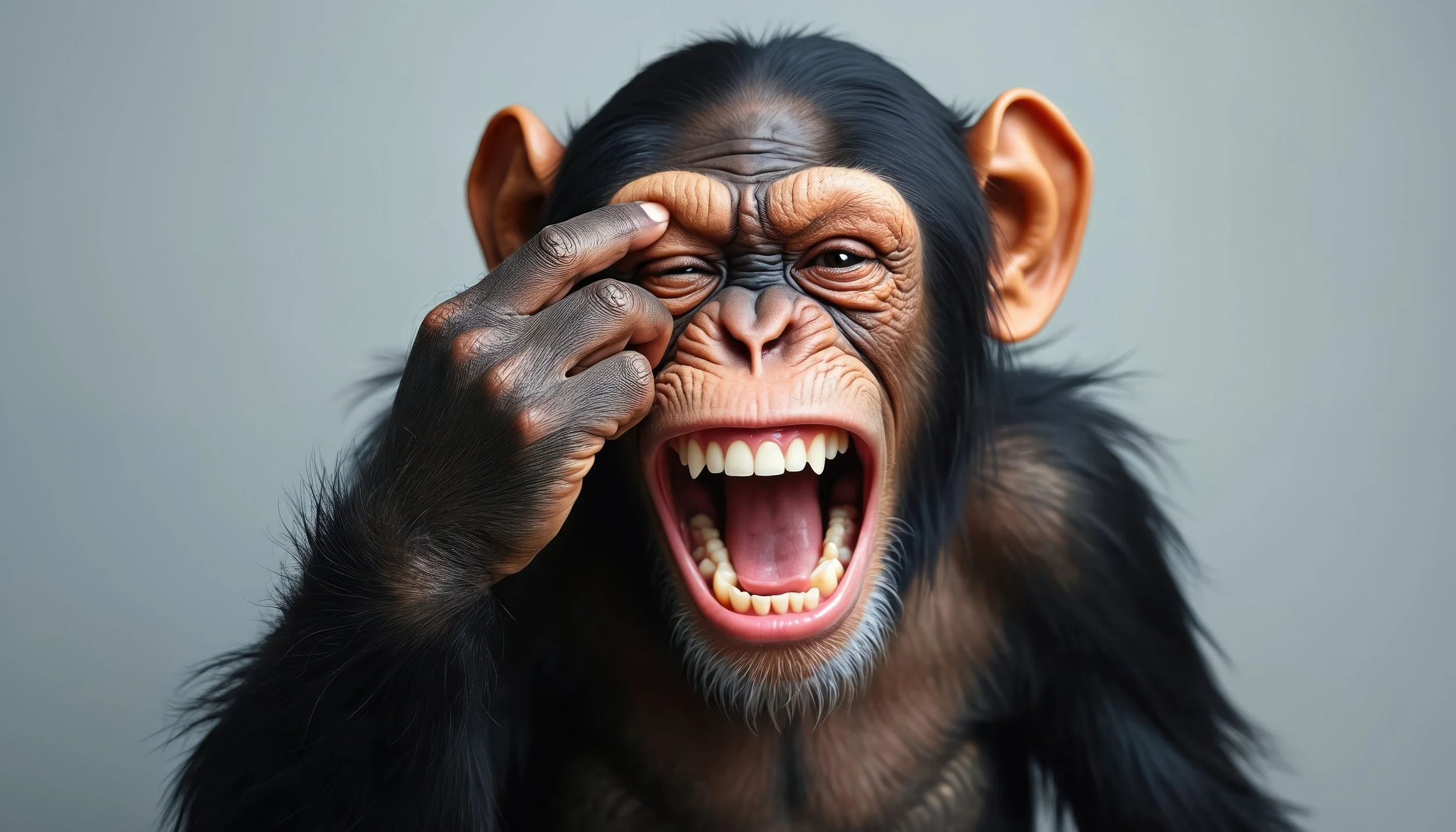
Prospects for the weekend, and maybe even for the next few years, got a little brighter after reading a terrific NYT article bearing the headline, "How Jagged Intelligence Can Reframe the AI Debate."
Okay, de gustibus non disputandum and all that good shit about no accounting for taste. But bear with.
The gist of the report is that while AI may perform at superhuman levels in many areas, it's bafflingly inept in others. As in the widely circulated story that AI replied to the question “should I walk or drive to the car wash that’s 100 meters from my house” with the self-defeating advice, "walk."
Turns out that plotting how the technology performs across various task categories doesn't produce the smoothly ascending curve of an omniscient super-intellect.
Instead, it looks more like an a-fib patient's EKG.
Andrej Karpathy, the OpenAI researcher who coined the expression "jagged intelligence," puts it this way: “Some things work extremely well (by human standards) while some things fail catastrophically (again by human standards),” he wrote on social media in 2024, “and it’s not always obvious which is which.”
The rimshot: AI doesn't have truly generalized brain power. Instead, it has "a lot of different skills."
And that's why yours truly is sporting a slight upturn of the lips, or, more accurately, an upward twitch at the corners as I write.
It gets better.
Because it seems the most promising ways for the AI-illuminati have to fill in the trenches between peaks "does not work as well in areas like creative writing or philosophy...where the distinction between good and bad is harder to pin down."
I don't know about your line of work, but from the narrow perspective of advertising and creative persuasion, it makes total sense.
Just imagine you had access to all the (online) information in the world, and were built to use that data as the basis for predictive output. Would that allow you to leapfrog history and convention and come up with the unexpected and surprising ideas that are so clearly the hallmark of successful advertising?
Hey, here's an idea: let's ask AI.
"At a technical level, modern AI systems are trained to model probability distributions over existing data. They learn patterns—linguistic, visual, cultural—dimensional interpolation across prior human expression, not a departure from it.
This matters because true creative novelty—especially in fields like advertising—rarely emerges from probability. It emerges from violation. Breakthrough campaigns don’t succeed because they are the most likely next sentence; they succeed because they are, in some sense, the least expected one that still works. They introduce a new frame, a new tension, or a new cultural angle that did not previously exist in the training data."
All of which is pure common sense. Which, as the dirty car still sitting 100 meters from the carwash shows, isn't AI's strong suit.
Jagged Truth
Previous
Previous
Declaring Independents.
Next
Next