Re: Centering.

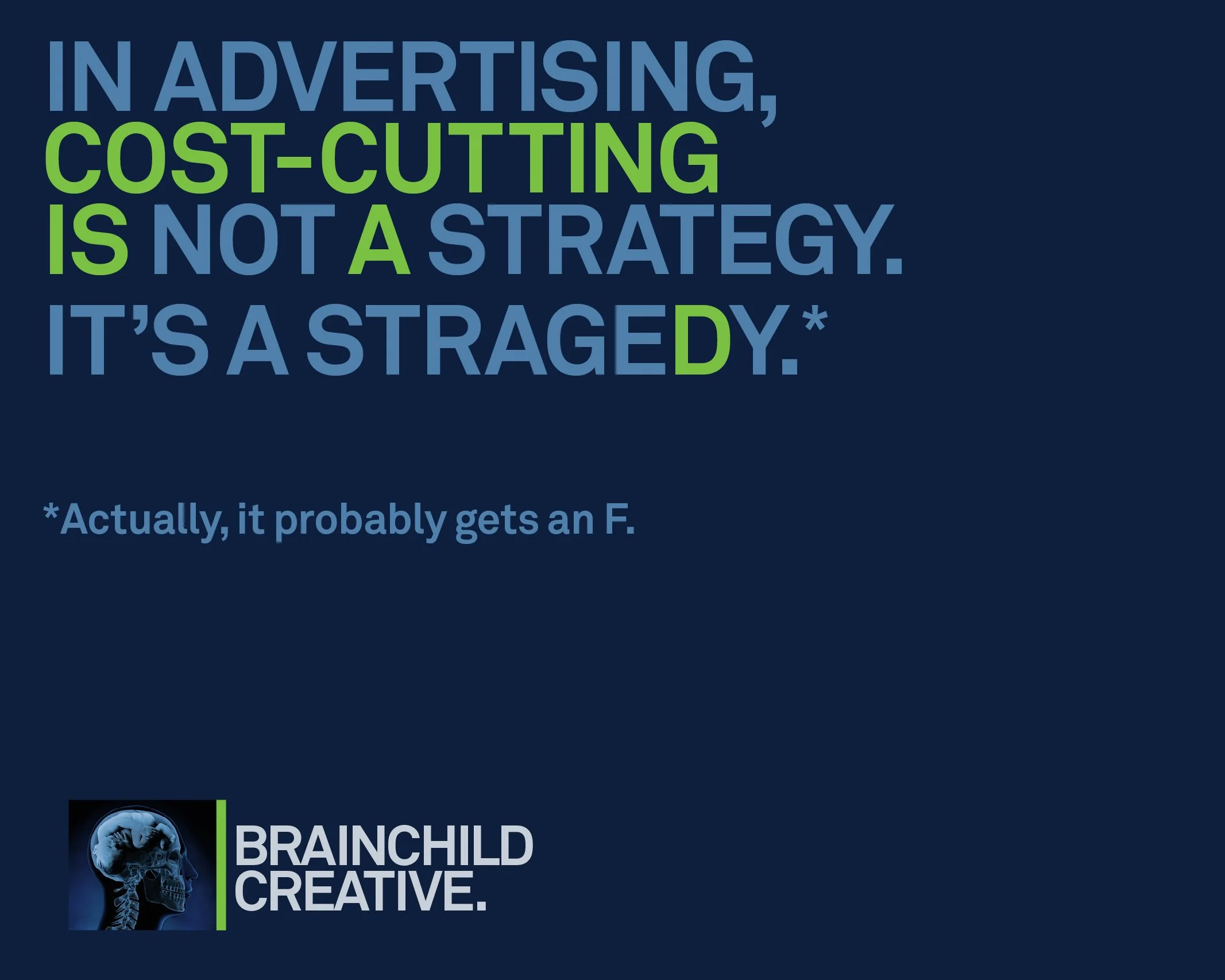
When major league corporate thinker Rita McGrath writes, “Cost cutting is not a strategy,” she was not fucking kidding.
Expletive not deleted is all mine, not hers; I’ve never met the lady and have no clue if she’s got delicate ears or a matching vocabulary.
But, on the upside, she really grabbed me by the attentions with a Fast Company article razor-dissecting how VW lost its way, its roadmap, and, for those who remember, its corporate fahrvergnügen.
I, of course, couldn’t resist making the mental advertising-related margin note: it’s also a perfectly fine way to make your brand vanish. And mighty damned efficiently, at that.
Next up: the temptation to see if AI could boil the thought down to headline brevity proves irresistible. Too bad, because this is what comes back:
“It’s a retreat with a spreadsheet.”
“It’s how brands become invisible efficiently.”
“It’s budgeting your way into irrelevance.”
“It’s silence at a discount.”
“It’s surrender dressed as fiscal discipline.”
And there you have it. AI again demonstrating its singular capacity to traverse the distance between banal, predictable, and write-by-numbers far faster than any mere human could hope to match.
In fairness, no diss to the technology: a hammer is a hammer is a tool. But while we're talking dubious strategies, we might want to add AI-improving-brand-comms to the list.
Still, it’s McGrath’s big picture thinking that keeps me prompting. In this case, diving deeper into what she calls a “structural economic shift” where the “old macro-financial order is giving way” to something different.
That different is a "dematerializing economy"—where value is less about physical assets and more about software, data, relationships, and other intangibles that don’t follow old school rules.
Which is precisely why it’s so “brutal” for companies still reverting to saved..
Her answer to being disrupted out of existence: “strategic centering”—nailing the most important opportunity, focusing resources against it, and getting all the horses pulling in the right direction.
Writ simply: Choose a center. Organize around it.
My next question: what would an ad agency centered to thrive in McGrath’s world look like?
Credit where due: this is where AI really showed me something.
The new North Star: creating and compounding customer demand around “consequential” market change.
The new remit: identify the shifts that matter, decide which (and how) to exploit.
The structure: small, cross-functional teams instead of large, siloed account groups.
The “product”: 360-degree creative “platforms” that extend, adapt, and stay durably coherent.
All of which, I have to say, points to something profound.
If value now comes from clarity, alignment, and focus, the answer isn’t to cut creative flesh, muscle, and bone. It’s to decide what matters and concentrate there.
Because for companies like VW and ad agencies alike, cost-cutting isn’t a strategy.
It’s what you do when you don’t have one.