The wonder of wonders.
Or maybe it’s more about fun with words.
As in deciding to plot your ideational profile against three useful variables, maybe we call them, “imagination,” “creativity,” and “intelligence.”
This is triangulation.
Add a fourth calibration point like “wisdom” and you’ve arrived at what I've just learned is called "quadrangulation."
Which is not only a nifty word but, as the remarkable Bob Brihn remarks, end-rhymes pretty damn well with “strangulation.”
But now let’s say we add a fifth plotting point reference called “curiosity.” This creates a map based on something called a “polygonal mesh” which I suppose could also be called a “polygonulization” if you’re fond of curious coinages.
Which, in turn, gets me curious to the point of wonder on this point: what happens if the mind doing the triangulating, quadrangulating, and polygonulating isn’t human, but artificial?
Would the meaning of those plot points be meaningfully different?
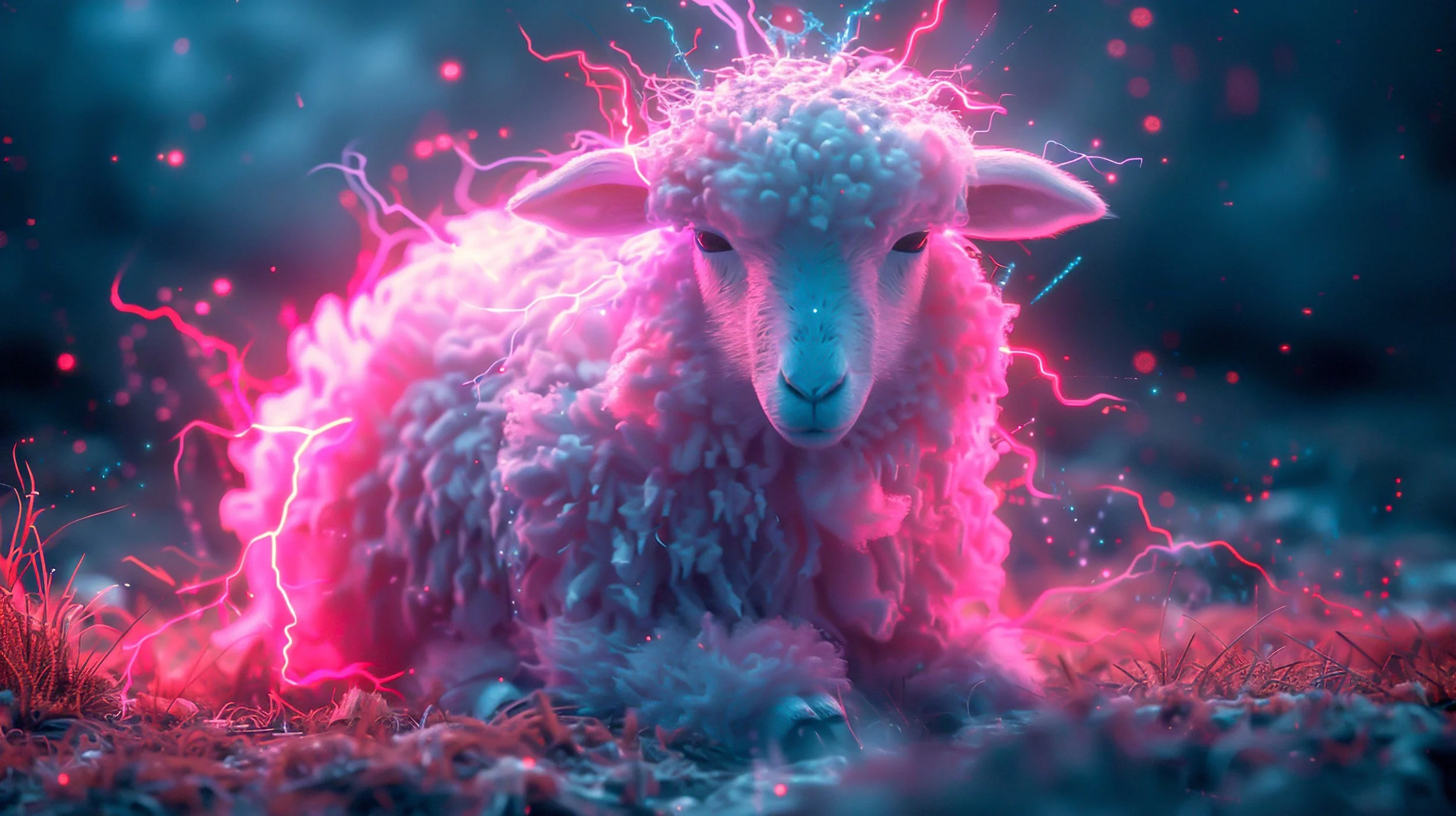
Philip K. Dick posed this exact question, albeit brilliantly, when he titled the book that turned into Blade Runner, “Do Androids Dream of Electric Sheep?”
His maybe-maybe-not answer was both ambiguous and variable, depending on whether you're thinking about the sheep or the dreams — human empathy or the sentient capacity to long for better.
Plunging headfirst down the rabbit hole, I prompt ChatGPT: “Is there a meaningful difference between asking a human versus asking AI to “imagine", to "be creative," or to "think intelligently"?
The reply was literal and linear: “When you prompt artificial intelligence to imagine, create, or think intelligently, you are initiating a highly sophisticated process of probabilistic reconstruction and latent-space navigation.”
Put into something close to English (and you bet I had to ask) it means that what comes back will be a mathematically generated simulation of the behaviors we associate with imagination, creativity, and intelligence.
Whether there’s a recognizable difference in the result—well, that’s entirely Zen. Because it’s quite clear that even present-day technology can output something new, novel, and even emotional.
What it cannot do falls under the heading of experience: the self-awareness of being imaginative, creative, intelligent, wise or curious.
To Descartes’ point that “I think, therefore I am,” AI ripostes, “I think, therefore I think.”
And this may be where “wonder” becomes the plot point that needs to be plotted.
Not just because I’m on team human when it comes to creativity, particularly in my chosen field of advertising, but because history is so clear that the act of “experiencing” not only changes us, but, on occasion, changes the world.
And that’s pretty wonder-full.